
 In my emotional intelligence (EI) article series, I identified four crucial building blocks that cooperate to provide a holistic lens into an EI-capable leader, as follows:
I believe the first three building blocks are prerequisites for the fourth. It would be incredibly difficult to relate for results without having a realistic understanding of your own strengths and weaknesses, how you come off to others, and the strengths, weaknesses and emotions of others. The four blocks can be expressed as follows Read more at ProjectManagement.com.
0 Comments
This part two of a three-part series on Mastering Credibility. Part one is It's What You Know and part three is It's How You Deliver Results. 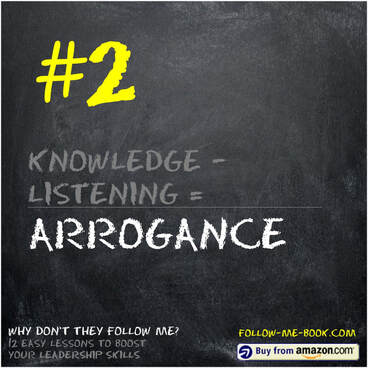
Ever since childhood, Mark had been known as an in-your-face competitor...
Whether it be in sports, in the classroom, or in relationships, he wasn't happy unless he beat someone else at whatever he was doing. Being in competition to Mark meant that he was going to do whatever he could to ensure he won and that his competitor lost. Those on his team loved his competitive spirit and encouraged it; those not on his team feared him. His behavior was validated through the number of trophies and medals he received while growing up. As an adult his competitive spirit didn't wane. He became a feared negotiator in his company's purchasing organization and became known as a pompous ass who would stop at nothing to ensure that his suppliers were giving up as much as possible so his company could get a better deal. Suppliers hated to deal with him, but his company was too big to ignore so they put up with him.
This is part one of a three-part series on Mastering Credibility. Part two is It's The Relationships You Build and part three is It's How You Deliver Results. 
Jeff was the quintessential schmoozer.
He was one of those guys who was the life of the party. He could walk into any room and instantly be the one that everyone else focused on. His charm, wit, and charisma was the envy of his friends and colleagues. Being in his senior year of college, Jeff saw huge dollar signs in his future as a salesperson. Though he was an average student with average grades, Jeff felt that his ability to wine and dine customers was going to be his ticket to being a big-money salesperson. With his wit and charm, how could customers resist?  I recently stumbled upon a leadership trend called “conscious unbossing.” It caught my attention, not because I knew what it was and wanted to learn more, but because it was such an odd phrase that I couldn’t unsee it and had to find out what in the dickens it was.
Claude and Copilot gave me very similar definitions: Conscious unbossing is the deliberate choice by talented professionals to opt out of—or step back from—leadership roles in favor of career paths that better align with their personal wellbeing, values, and definition of success. Okay, I can buy this; a professional makes a conscious choice to not climb the ladder and organizationally lead others. Some were meant to be a thought leader and are more sustainably content than in a people-leader role. Chasing a promotion because a professional thinks that’s what they’re supposed to do as opposed to what fits into their life doesn’t make sense. I’ve seen many professionals who opted to move into individual contributor (IC) roles because they wanted to have thought leader impact without the stress of being a people leader. The Claude/Copilot definition holds water in my book. Read more at ProjectManagement.com.
|
Topics
All
Reprints
Contact Lonnie about article reprints. Please specify article you wish to reprint. Backlist
See Lonnie's Amazon Author Page Archives
October 2026
|
 RSS Feed
Lonnie Pacelli - Building Thriving Leaders™
Insightful | Creative | Direct Advice to Help Leaders Help Themselves
Keynote Speaker | Board Director | Autism Advocate | Author | Project Management Expert | Microsoft/Accenture Veteran
See his books on Amazon
Insightful | Creative | Direct Advice to Help Leaders Help Themselves
Keynote Speaker | Board Director | Autism Advocate | Author | Project Management Expert | Microsoft/Accenture Veteran
See his books on Amazon
Services |
About
|
© COPYRIGHT 2019. ALL RIGHTS RESERVED.
We are a participant in the Amazon Services LLC Associates Program, an affiliate advertising program designed to provide a means for us to earn fees by linking to Amazon.com and affiliated sites.
|